Meetily vs Granola: open source vs cloud notes
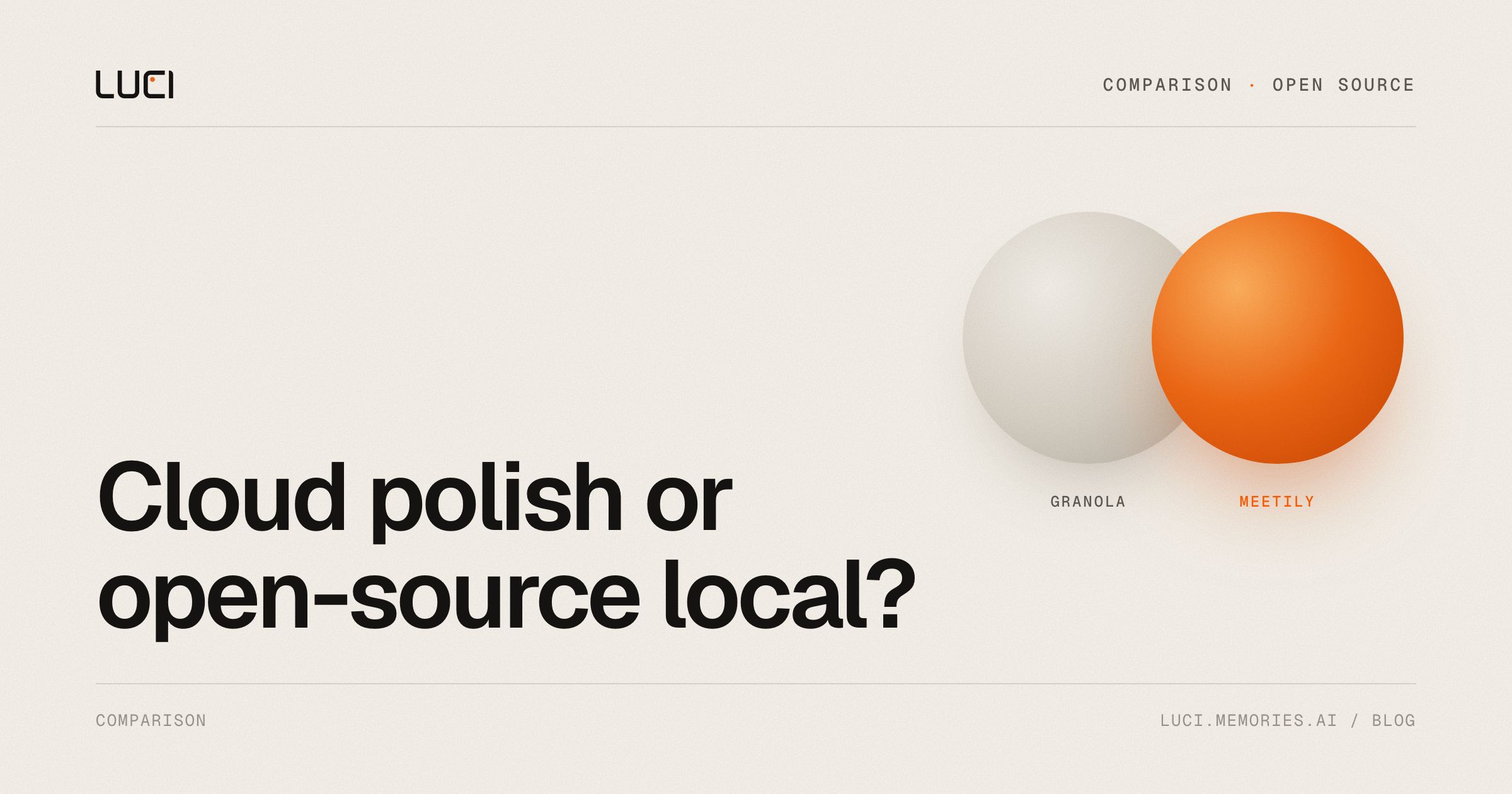
These two get compared constantly and they are not really competing for the same person. Granola is a polished cloud product that happens not to send a bot. Meetily is a self-hosted transcription stack you assemble yourself. Picking between them is mostly a question of what you would rather spend: money and trust, or an afternoon.
Both skip the meeting bot, so neither one puts a stranger in your Zoom roster. That is where the similarity ends.
The short version
| Meetily | Granola | |
|---|---|---|
| License | MIT, source on GitHub | Proprietary |
| Where audio is transcribed | Your machine, via Whisper | A cloud transcription provider |
| Where transcripts live | Your disk | Granola's servers, US-hosted AWS |
| Bot in the call | No | No |
| Speaker labels | Pro tier only | "Me" and "Them" on desktop |
| Cost | Free, Community Edition | Paid, per seat |
| Setup | You install and configure it | Download and sign in |
| Trains on your data | No | Non-Enterprise accounts, unless you opt out |
Where Granola wins
It works immediately. You install it, sign in, and the notes are good. Granola's summaries are the best part of the product and the reason people stay: the transcript is raw material, and what you actually read afterwards is a clean set of notes that got the decisions right. Meetily gives you a transcript and a local model's attempt at a summary, and the gap in polish is real.
Granola is also the better answer if you are buying for a team. Shared workspaces, folders, and a colleague being able to open a note without cloning a repo all matter more than people admit when they are choosing tools alone.
Where Meetily wins
Nothing leaves your machine. Whisper runs locally, the transcript is a file on your disk, and there is no provider in the middle with a copy. For anyone under a confidentiality obligation that is not a preference, it is the requirement, and Granola cannot meet it. Granola's own security page documents cloud transcription and US-hosted storage, and non-Enterprise accounts feed anonymized data into training unless you go turn that off.
The license matters too. MIT means you can read what it does, fork it, and keep running your 2026 install in 2030 regardless of what happens to the company. That is not hypothetical caution. The last screen-memory product a lot of people relied on was Rewind, and Meta shut it down in December 2025.
Where both of them disappoint
Speaker labels, from different directions.
Meetily's Community Edition ships without diarization. It is a Pro feature. meetily#226 has been open since October 2025 with 14 reactions and no comments, which is its own kind of verdict, and meetily#230 has been running since October 2025 with the argument about whether it belongs behind a paywall. The maintainer's answer on 2026-07-20 was technical rather than commercial: an open-source diarizer was tested and the accuracy was not good enough to ship. I respect that more than shipping something that mislabels a third of the call, and it still leaves the free tier without labels.
Granola does not have a paywall problem here. It has an architecture problem. On desktop you get "Me" and "Them", because the app can separate your microphone from system audio but not the four voices already mixed inside system audio. Real speaker identification is scoped to in-person capture on iPhone. On a five-person Zoom call, both tools leave you guessing.
The other shared weakness is that both are meeting-shaped. Everything is a per-call file. Neither one knows what was on your screen while you were talking, which is where most of the context in a working day actually lives.
Setup cost, honestly
Meetily is free the way a kit car is free. You are installing a local Whisper model, wiring up audio capture, and choosing a local LLM for summaries. If you are comfortable with a terminal this is an evening. If you are not, it is a weekend that ends badly. Check the current release for which platforms have builds before you plan around it, and note that release cadence on the repo is not fast.
Granola's setup cost is roughly zero, with one recurring tax: it does not reliably auto-record. You generally need a note open when the call starts, and the most common Granola complaint is a meeting that produced nothing because nobody clicked in time. More on that failure and how to avoid it.
Which one to pick
Pick Meetily if the audio genuinely cannot leave your machine, you want the source, and you will accept doing the assembly and living without speaker labels on the free tier.
Pick Granola if you want good notes today, you are buying for a team, and cloud transcription of your meetings is something you can sign off on.
Pick neither if what you actually want is for the meeting to stop being a separate artifact from the rest of your work. That is the case for LUCI: meetings are captured on-device on Mac and Windows with no bot and no transcription provider, speakers are separated locally rather than gated behind a tier, and the transcript joins your computer's history instead of landing in its own file. A question like "what did we agree on with this client, and what was on my screen when we agreed it?" resolves to one answer with sources.
Side by side in LUCI vs Meetily and LUCI vs Granola. If you came here looking for an open-source Granola replacement specifically, Granola alternatives is the fuller list.