Screenpipe Too Much Maintenance? 4 Ways Out
Almost nobody leaves Screenpipe because of what it captures. They leave because of what it asks of them afterwards: you run the stack, you keep it running, and you write whatever sits above the raw capture yourself. That is a fair trade for developers who wanted raw material in the first place — and a bad one for everyone who just wanted their computer to remember things. This post is for the second group.
We build LUCI, and it's ranked first here — said upfront so you can weigh the rest accordingly. But three of the four other tools below are the right pick for specific people, and we say who.
What Screenpipe alternatives are actually being searched for
Two threads on Screenpipe's own GitHub issues describe the trade-offs people are working around directly. One reports the app pushing past 100% CPU and 10GB of RAM while its own status still read "healthy" (source). Another documents scheduled pipes repeatedly triggering macOS permission prompts for the Documents folder because pipe scripts could run unrestricted filesystem commands (source). Neither is a dealbreaker for the audience Screenpipe is built for — people comfortable running and tuning their own local pipeline — but they're exactly the kind of maintenance overhead that sends other people looking for something that works out of the box.
How we're ranking these
Four questions separate the options, since every tool here captures your screen in some form:
- Search, or understanding? OCR over screenshots lets you find a string you remember. Understanding the capture lets you ask what you were doing.
- Does the capture leave your machine? Screenpipe's core promise is that it doesn't. Not every "alternative" marketed against it keeps that promise.
- Does it hear meetings too, or is it screen-only?
- Can your coding agent query it directly, or do you have to write the integration yourself?
The ranking
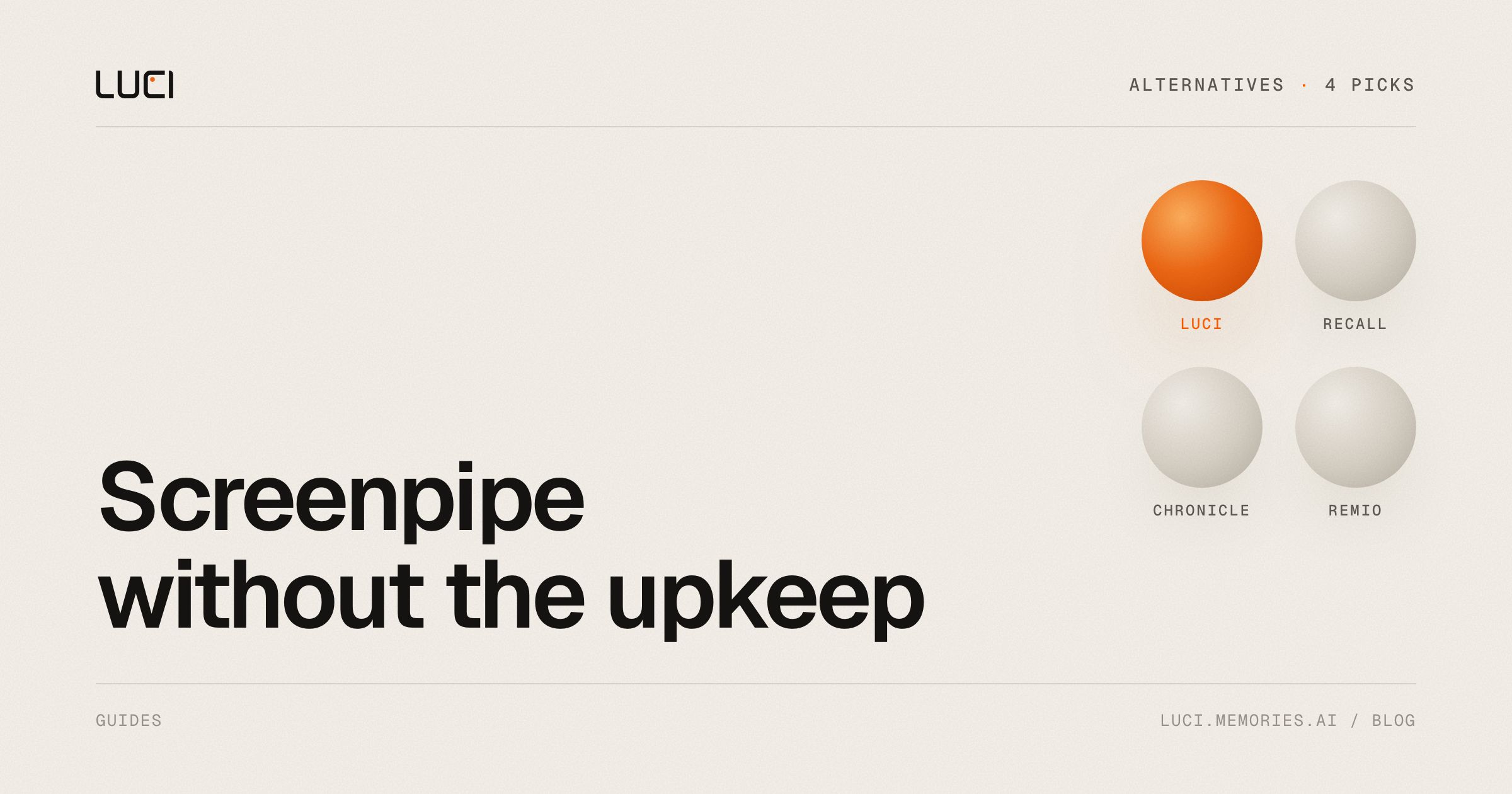
1. LUCI — best overall replacement
LUCI keeps the property that makes people choose Screenpipe in the first place — everything processed and stored on your own machine, working with the network unplugged — and builds the layer Screenpipe deliberately leaves for you to write. It understands what it captures rather than only extracting text, folds screen activity and meeting audio into one memory, and answers plain-language questions with citations back to the moment. Cards, keys, and passwords are blacked out before anything is saved.
The bigger difference: your agent writes your Life, a daily distillation of your work, and Claude, Cursor, and Codex can recall it through the Agent Bridge — LUCI connects itself, nothing to configure. Of the tools on this list, LUCI is the only one where agent access ships built in rather than something you write yourself.
Honest trade-off: no Linux build, and sessions run up to four hours by design rather than a permanent always-on firehose — a real limitation if what you want is Screenpipe's literal 24/7 capture. And LUCI is closed-source, so unlike Screenpipe you can't read the code that handles your data; its privacy claims rest on behavior you can verify (capture and search keep working offline) rather than on a public repository.
Best for: people who want Screenpipe's local-only guarantee with an understanding layer, a cross-session memory, and direct agent access already built in.
→ LUCI vs Screenpipe · Full Screenpipe alternatives comparison
2. Microsoft Recall — best for Windows users who already qualify
If you're on Windows and already own a Copilot+ PC, Recall costs nothing extra and needs no setup — the exact opposite of Screenpipe's trade. It's built into the OS, keeps snapshots on-device with keys held in a VBS enclave, and for simply retracing your own steps on qualifying hardware, that's a real advantage.
The honest limits: it's Windows 11 24H2+ only, gated on specific hardware (a 40-TOPS NPU and 16GB RAM), and per Microsoft's own documentation it records no audio at all, so meetings are entirely out of scope. Independent testing has also shown its sensitive-information filter can miss credit card and Social Security numbers, and it's disabled by default on managed enterprise devices.
Best for: Windows users on qualifying Copilot+ hardware who only need to retrace their own screen activity, not meetings.
3. OpenAI Codex Chronicle — best for Codex-only users on macOS
Chronicle is the most interesting design on this list: a two-stage pipeline where one model extracts candidate memories and another consolidates them in the background, deliberately keeping only durable context — your stack, conventions, recurring workflows, known pitfalls — rather than a full raw archive.
It inverts Screenpipe's central promise, though: screenshots are uploaded to OpenAI, so the capture leaves your machine, and it's boxed to macOS, ChatGPT Pro, and Codex specifically. Because extraction is deliberately lossy, detail it judges one-off is discarded with no raw record to drill back into — the opposite of Screenpipe's philosophy of keeping everything.
Best for: Codex-only users on macOS who mainly want their coding agent to stop re-asking the same setup questions, and don't need a general-purpose archive.
4. Remio — best for the widest automatic capture, if cloud is acceptable
Remio covers a wider surface than Screenpipe out of the box — continuous screen capture, browser activity, and audio transcription, with agentic retrieval over what it collects — and needs no setup on Mac or Windows.
It's cloud-based, though, so the capture leaves your machine, which is the opposite of why most people pick Screenpipe in the first place. If you specifically chose Screenpipe because the archive was local and auditable, this is the wrong shape regardless of how much more it does.
Best for: people who want the broadest automatic capture across apps and browser tabs, and are fine with cloud processing.
Screenpipe alternatives compared
| Tool | Processing | Captures meetings | Agent access | Linux | Price |
|---|---|---|---|---|---|
| LUCI | On-device | Yes | Yes — Claude, Cursor, Codex | No | Free |
| Microsoft Recall | On-device (Copilot+ PC) | No audio | No | No | Free with hardware |
| Codex Chronicle | Uploaded to OpenAI | No | Codex only | No | ChatGPT Pro |
| Remio | Cloud | Yes | No | No | Check their pricing page |
| Screenpipe (staying put) | On-device | Audio only | Write it yourself | Yes | Check their pricing page |
Can you use both? Yes. Developers who need Linux coverage commonly keep Screenpipe on that box and run LUCI on their Mac or Windows daily driver — there's no rule that a Screenpipe replacement has to cover every machine you own.
Frequently asked questions
What is the best Screenpipe alternative overall?
LUCI, for most people — it keeps Screenpipe's on-device processing and adds understanding, cross-session memory, and direct agent access. Microsoft Recall is the better pick if you're already on qualifying Windows hardware and only need screen history, not meetings.
Is there a free Screenpipe alternative?
LUCI is free, with sessions up to four hours and no monthly quota, processed entirely on-device. Microsoft Recall is free if you already own a Copilot+ PC. Screenpipe itself is a one-time purchase — check their pricing page for the current figure.
Which alternatives keep everything on my machine, like Screenpipe does?
LUCI and Microsoft Recall both process and store on-device. Codex Chronicle uploads screenshots to OpenAI, and Remio is cloud-based. The test that settles it for any tool: disconnect from the network and see whether capture and search still work.
Does anything here run on Linux, like Screenpipe?
Not currently — LUCI, Microsoft Recall, Codex Chronicle, and Remio are all Mac and/or Windows only. If Linux is a hard requirement, staying on Screenpipe is a defensible answer, and running LUCI alongside it on your other machines covers the rest.
Can my coding agent search what these tools capture?
LUCI exposes its memory to Claude, Cursor, and Codex through the Agent Bridge, with nothing to configure. Codex Chronicle feeds memories to Codex specifically, but the screenshots go to OpenAI first. Screenpipe, Microsoft Recall, and Remio have no equivalent — with Screenpipe you'd write the integration yourself.