Life memory for therapists, between the sessions
Thursday, 3:58pm. The client you last saw three weeks ago is about to appear on the screen, and what you have is a progress note that reads "explored conflict with sister; homework: journaling." You wrote it at 9:20 that night, tired, and it is technically accurate and practically useless. You remember there was a sentence about the sister that mattered, something about a promise made at a funeral. You do not remember the sentence. You have ninety seconds.
So you do what everyone does. You open the session with a general question and let the client re-establish the thread, which costs you four minutes of a fifty minute hour and quietly tells them you did not carry them with you.
The gap is not the note, it is everything around the note
Documentation tools address the wrong end of this. The problem is not that writing the note is slow, though it is. The problem is that the note is a lossy summary of one hour, written under fatigue, and by the time you need it three weeks later the detail you actually want was never the detail you thought to write down.
LUCI works differently because it is not a notetaker. It is your computer's history and your personal memory of your working life. Your whole day on the computer: sessions, email, notes, everything in between. On a telehealth call it captures both sides of the audio with nothing joining the call, so no participant named after a software company appears in the frame you spent months building. It also captures what was on your screen, the intake form you re-read, the article you looked up about a medication, the referral email you drafted and did not send. Everything is understood on-device and stored encrypted on your machine, and nothing about your memory is processed in a cloud. Cards, keys, and passwords are blacked out before anything is saved, and private windows can be excluded.
Four ways this shows up in a practice
The ninety seconds before the hour. You ask in plain English: "what did this client say about their sister in our last three sessions." You get the actual language, not your paraphrase of it, and you walk in holding the thread instead of fishing for it.
Patterns you would only catch by accident. "When has this client brought up sleep, and what was happening in their life each time." Continuity of care is mostly a memory problem dressed up as a clinical one. Six months of sessions is more material than any clinician can hold in working memory, and the pattern is usually visible only once you can line the mentions up.
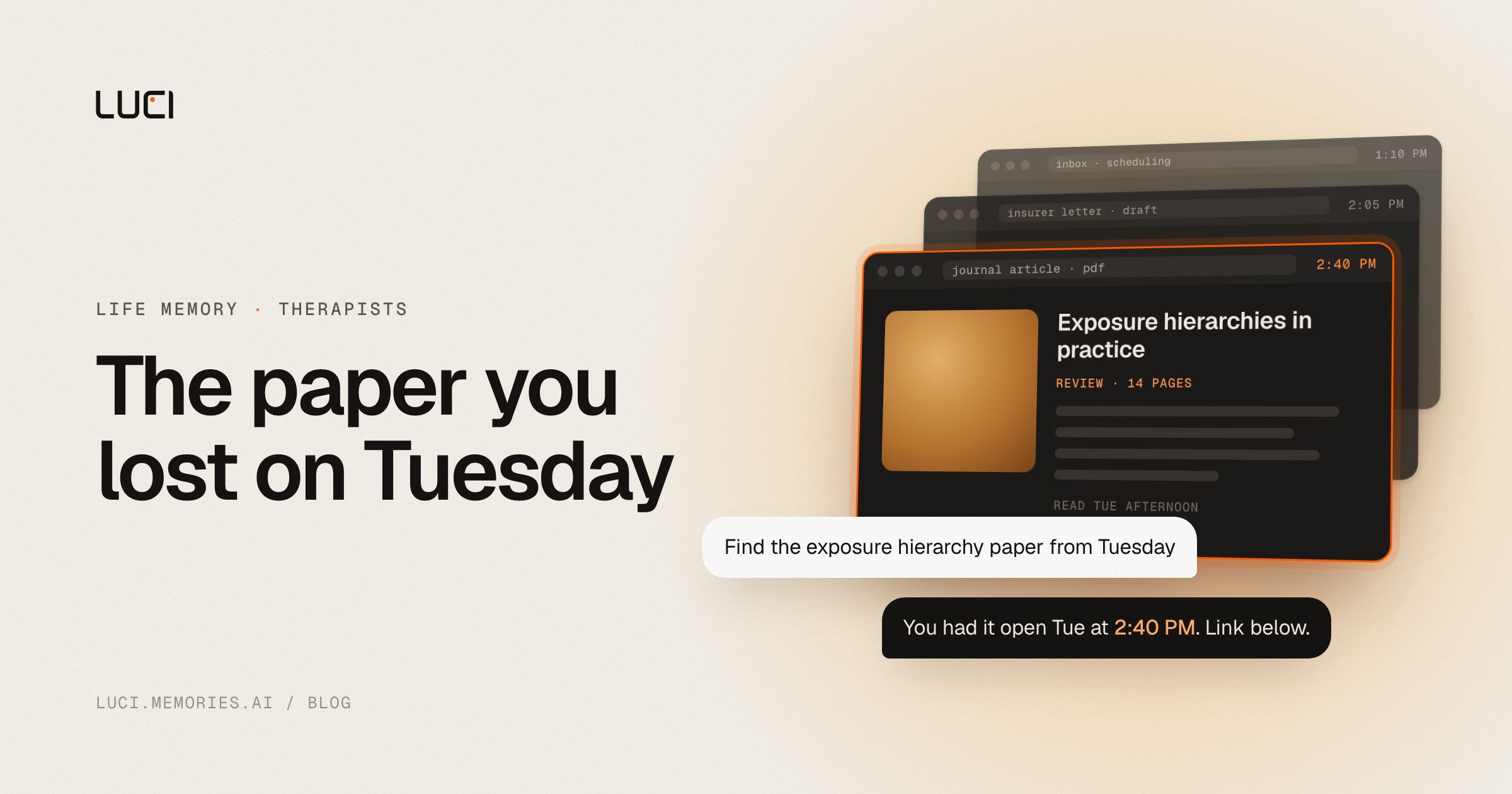
Your own week, alongside your clients'. The consultation call you had about a difficult case, the training video you half-watched, the article you found and lost. "The paper I had open Tuesday afternoon about exposure hierarchies." It is your professional life on that machine, and the clinical work is one part of it.
A record that outlives the software. Your agent distills each day and writes your Life: a folder of ordinary files on your disk. Plain files, readable in any text editor, still readable when this app and every app like it is gone. That matters more in a field with retention obligations measured in years than in almost any other.
The honest part, because this is PHI
Session content is the most sensitive material in healthcare, so here is the shape of it without softening. Capture, understanding, and storage all happen on your machine, encrypted, with no vendor receiving the audio. That is why there is no business associate to sign a BAA with: there is no third party in the loop. It also means the security of that laptop is entirely yours. Full disk encryption, a real password, backups you control, and a lock screen habit. LUCI does not change your obligations under the Security Rule, and it does not change the consent conversation you owe your client before recording anything, which roughly a dozen states require by statute anyway.
The agent is where you need to be most deliberate. Your memory stays on your machine, but what an agent reads reaches that model's vendor. Point Claude at a session and Claude's provider sees what Claude reads. For PHI that is a decision with compliance weight, not a convenience setting, and the defensible default for most private practices is to search your own memory yourself and keep the agent for the parts of your work that are not clinical: scheduling, admin, your own reading, drafting the letter to the insurer. The structural advantage is that you choose the agent and the memory outlives it, rather than a vendor holding both. Two more things worth saying plainly: LUCI is not open source, so our on-device claim is one you have to weigh rather than audit, and it only remembers what happened while the machine was on and capturing. An in-person session across a room from a closed laptop is not in there at all.
Where to start
Try it on the administrative half of your week first, the part with no PHI in it, and see whether the recall is worth anything before you decide anything about sessions. That is the right order.
Download LUCI for Mac or Windows, free, or read the compliance detail on our page for therapists.