Life memory for sales teams: deal history, recalled
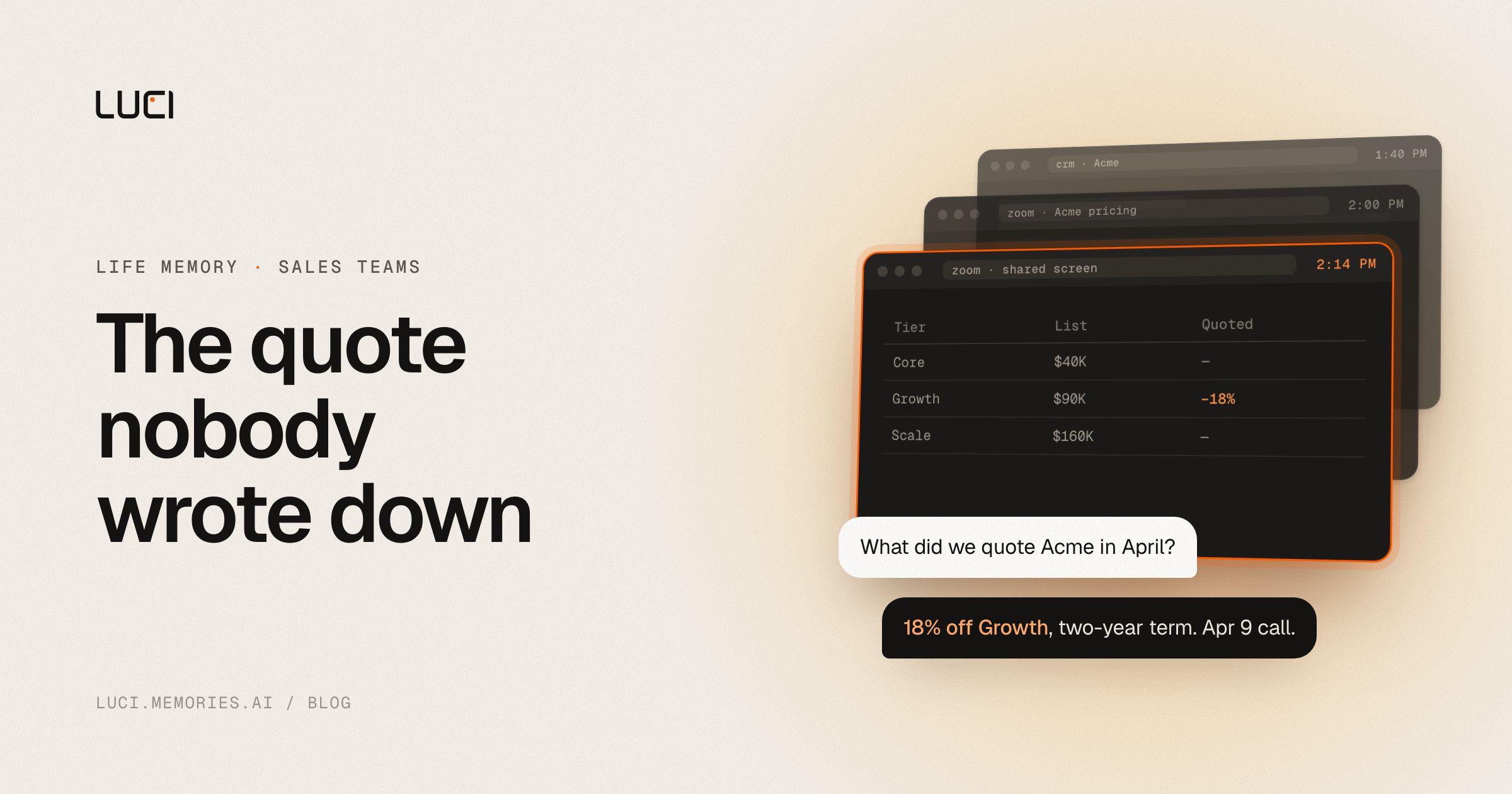
Thursday, 3pm, renewal call with Acme. Their new finance lead says the number in front of her does not match what she was told in the spring. The AE who ran that cycle left in June. So: what did we quote them in April?
The answer exists. It is in a Zoom call from April 9, where the AE walked through three tiers out loud and said the middle one was eighteen percent off list on a two year commitment. It is in a follow up email sent from a phone at 9pm that never made it into the CRM. It is in a pricing spreadsheet that sat on screen for four minutes while they scrolled it together. Three places, none of them searchable as one thing, and the rep on the call has about nine seconds before the pause gets expensive.
This is the shape of most sales pain, and it is not a note taking problem. Notes are what somebody chose to write down. The problem is everything nobody chose to write down: the aside about their procurement freeze, the competitor name that came up once, the screen the buyer shared for thirty seconds showing their current stack.
What changes when the computer remembers
Everything you work on passes through your computer. The calls, the mail, the spreadsheet, the contract redlines, the LinkedIn tab you had open while you were talking. LUCI captures your whole day on the computer: meetings, email, quotes, everything in between. Both sides of the call audio, not only your half. It runs on Mac and Windows, it is free, and everything is understood on device and stored encrypted on your machine.
Then your agent, Claude or Cursor or Codex, connects through the Agent Bridge. Nothing to set up, LUCI connects itself. From that point on the agent you already talk to every day can ask your memory questions in plain English and read only what the question needs.
The difference is not a better notes page. It is that the deal history stops living in the head of whoever was on the call.
The version of the deal that actually happened
CRM records are a summary of a summary, written by someone who wanted to stop doing admin and go home. A life memory is the record underneath.
Ask your agent: what price did we quote Acme in April, and who was on that call. Or: list every time this buyer mentioned a competitor, and what they said. Or: when did procurement first come up in this deal.
Those questions do not need you to have tagged anything. The April call happened on your machine, so it is in your memory, and the phrase "eighteen percent off list" is findable whether or not anyone typed it into a field.
CRM updates drafted from real conversations
Pipeline hygiene fails for a boring reason. Filling in fields is a second job that happens after the work, when the details have already gone soft.
Give your agent the memory and the direction reverses. Ask it to draft the update for the three calls you ran today: what stage each deal moved to, what the next step is, who committed to it, and by when. You read the draft and fix what is wrong. The draft is built from what was said on the call, not from what you can still remember at 6pm on a Friday.
Same for follow up mail. Write the recap to the Acme team, using what we actually agreed, and flag the two things they asked us to confirm. The value is the source material, not the prose.
Objections you have already answered
Every team has a rep who handles the security objection well and four who improvise it. That knowledge is sitting in call audio nobody replays.
Ask: how have I answered the data residency objection, and what did the buyer say next. Or, before a call: what did we discuss with this account the last three times, and what did we promise. Ten seconds of prep that used to be twenty minutes of scrolling, and it includes the things that never got written down.
The handoff
Territory changes, a rep leaves, an AE hands off to customer success. Today this is a thirty minute meeting plus a document that skips the important parts.
Your agent distills each day and writes your Life: a folder of ordinary files on your disk, in formats anything can read, which outlives any app including LUCI. Ask it to write up everything on this account since January, quotes, objections, promises, people, and you get a handoff document with the actual chronology in it.
What this does not do
Some honest edges. If you point Claude or Codex at your memory, what that agent reads reaches that model's vendor. Your memory stays on your machine and only what a query needs gets read, but a connected agent is a connected agent. You choose which one, and the memory outlives whichever you pick. LUCI is not open source, so the local processing claim is one you take from us and can verify with a network monitor rather than by reading our code. It needs the machine on and capturing, so a call you took on your phone in the car is not in there. And it captures your day, not your teammates' days, which means team wide deal history means every rep running it. Private windows can be excluded, and cards, keys, and passwords are blacked out before anything is saved.
Start with one deal
Run it for a week, then ask your agent something you would normally give up on. What did we tell this account about the integration timeline. Who asked for the security review. What was the discount we floated and never sent.
If the answer comes back with the date and the sentence attached, you already know what the rest of the quarter looks like.
Download LUCI for Mac or Windows, or see how the pieces fit together for sales teams.