Life memory for knowledge workers: where did I see that
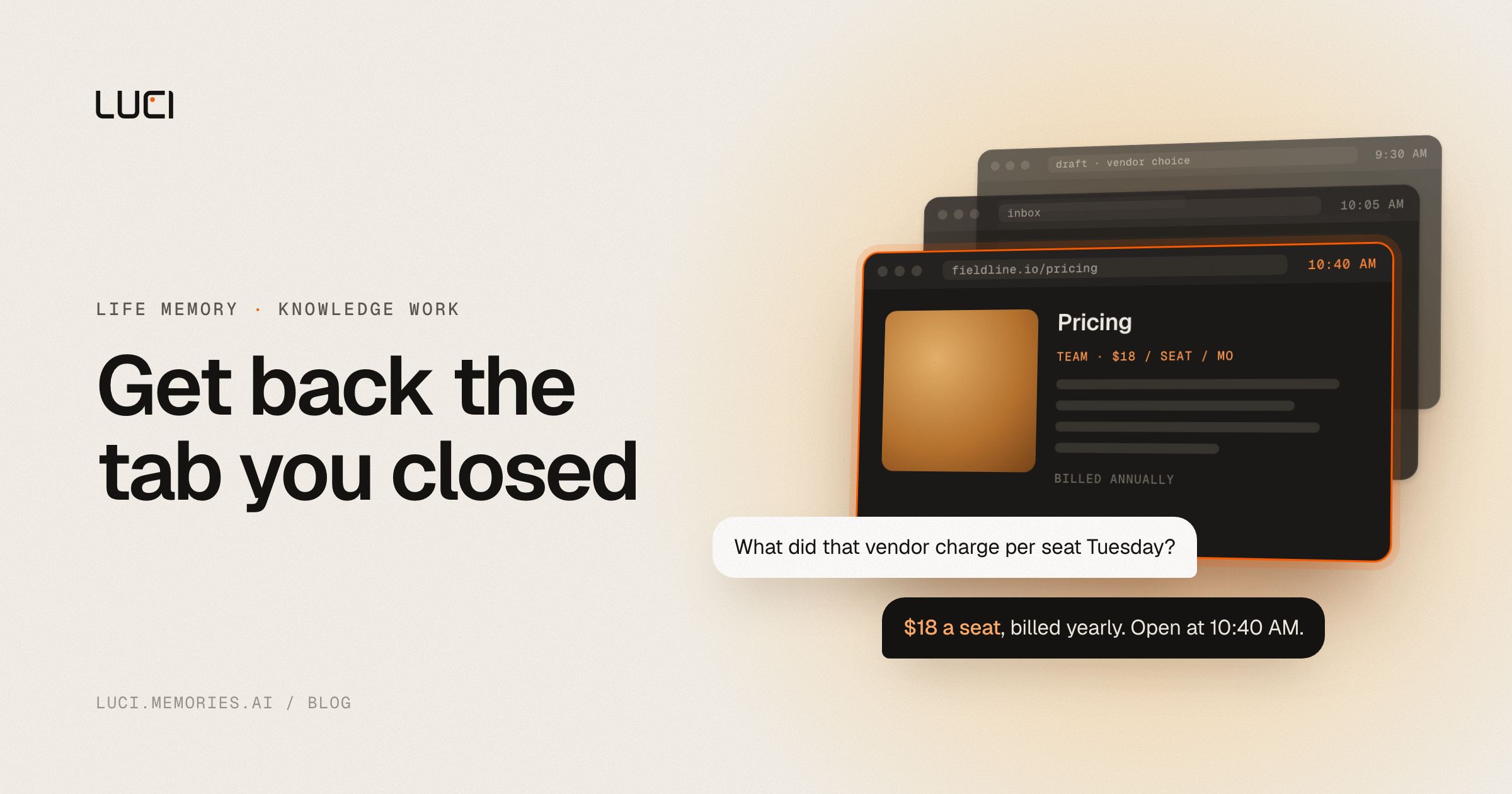
Tuesday, 4:40pm. You reopen the doc you abandoned at 11:15 that morning. Since then: two calls, a Slack thread that turned into a small fire, a vendor demo, and lunch at your desk while reading something you now cannot name. The doc has a half finished paragraph and a comment from your manager asking why you went with the second option.
You did have a reason. It was in a tab, next to two other tabs, one of which had the pricing that made the reason obvious. The window is closed. You reopen the vendor's site and the pricing page has changed. You spend twenty minutes reconstructing your own thinking from that morning, get it eighty percent right, and write a slightly worse version of the answer you already had.
Multiply by every context switch. That is where the day goes.
The problem is not memory, it is retrieval
You do not actually forget things. You lose the handle. The information was on your screen, in a call, in a thread, in a PDF, and it is still technically somewhere, spread across nine apps with nine search boxes, none of which knows about the others.
Everything you work on passes through your computer. LUCI captures your whole day on the computer: meetings, email, code, everything in between. Screen, documents, browsing, and both sides of the audio on calls. Mac and Windows, free. Everything is understood on device and stored encrypted on your machine. Private windows can be excluded, and cards, keys, and passwords are blacked out before anything is saved.
Then the agent you already use, Claude or Cursor or Codex, connects through the Agent Bridge. LUCI connects itself, nothing to set up. It asks your memory questions in plain English and reads only what a question needs.
Where did I see that
The most common thought in knowledge work, and the one no tool answers, because the thing you are looking for was never a file you owned.
Ask: what was the pricing on the vendor page I had open Tuesday morning. Or: I saw a paragraph about the retention policy last week, which document was it in. Or: what was that library someone linked in the architecture thread.
The useful part is that you can describe it badly. Roughly when, roughly what it looked like, roughly what you were doing at the time. That is how human recall works, and it is enough.
Picking a thread back up
Coming back to work after three hours away is a small research project about yourself. What was I doing, what was I about to do, what did I decide.
Ask your agent for the reconstruction instead of doing it. What was I working on this morning before the standup, and what was open. Then: what did I say about the migration on the 2pm call. In under a minute you are back at the eighty percent version of your own state of mind, which beats the version you rebuild from vibes.
At the end of the day your agent distills what happened and writes your Life: a folder of ordinary files on your disk, in formats anything can read, which outlives any app including LUCI. Not a dashboard. Files. Tomorrow morning it is the fastest way to remember who you were yesterday.
Handing your agent real context instead of re-explaining
This is the one that changes how the day feels. Right now, every session with an assistant starts with you typing background. What the project is. What we decided. What the constraints are. What the client said. You are the integration layer between your own week and the model, and you do that job several times a day, badly, from memory.
Give the agent your memory and that preamble mostly disappears. Read what we decided about the auth rewrite over the last two weeks and draft the design note. Or: I need to reply to this email, check what we actually told them about the timeline first. Or: write the weekly update from what I worked on, and flag anything I said I would do and did not.
The output quality difference is not subtle, and it is not about the model. A model with no context writes plausible generic work. The same model with your actual week writes something you only have to correct.
Why a decision was made
Six weeks later somebody asks why the schema looks like that. The answer was a fifteen minute tangent on a call, a benchmark someone screenshared, and a Slack message that scrolled away. The doc records the decision and not one word of the reasoning.
Ask: when did we first discuss moving off the shared table, and what were the objections. This is the query that makes people stop treating the whole thing as a novelty.
What this does not do
Honest edges. Connecting an agent means what that agent reads reaches that model's vendor. Your memory stays on your machine and only the parts a query needs are read, but Claude sees what Claude reads. You choose the agent, and the Life folder outlives whichever one you choose. LUCI is not open source, so on device processing is a claim you verify with a network monitor rather than by reading our code. It needs the machine on and capturing, so the whiteboard session in the meeting room and the work you did on your phone on the train are gaps. It knows your day and not your team's days. And a memory of everything is not a plan: it answers what happened, not what you should do about it.
Try the query you gave up on
There is a specific thing you looked for last month and could not find. Run LUCI for a week, then ask your agent for it in the sloppy words you would use with a colleague.
That is the test. Everything else is marketing.
Download LUCI for Mac or Windows, or see the longer version for knowledge workers.