A life memory for investors: who said what number
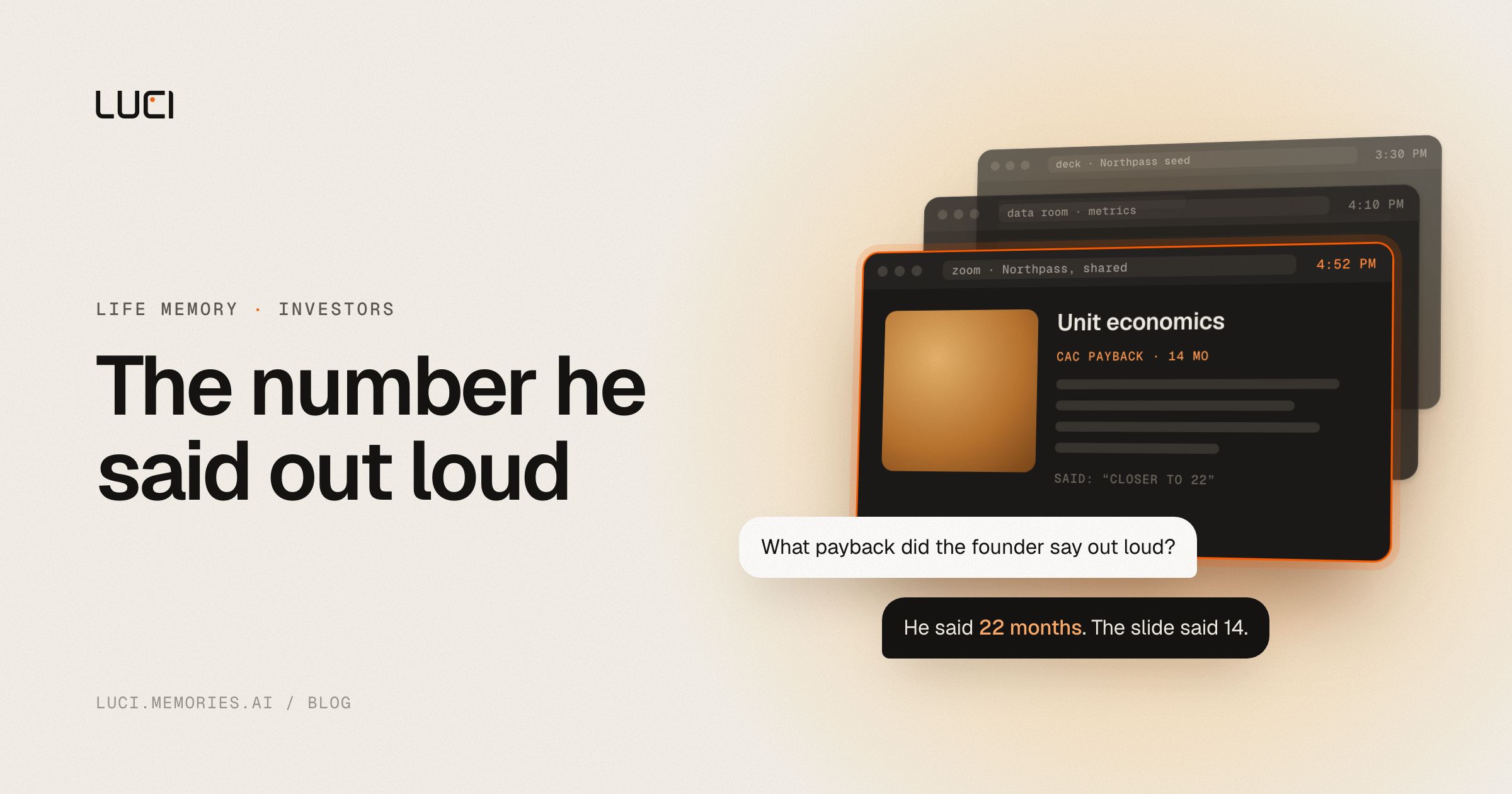
Monday partner meeting. Someone brings up the infrastructure seed you screened six weeks ago and asks what the founder said about payback period.
You remember the call. Tuesday, late afternoon, the seventh of nine that day, a founder who talked fast and shared a deck he clearly rebuilt the night before. You remember liking him. You do not remember the number. The deck in your inbox says fourteen months, but you have a strong feeling he said something different out loud and corrected himself, and the difference between fourteen and twenty-two is the entire argument for or against the deal. Your notes from that call are five bullets, and one of them says "CAC?" with no answer.
So the meeting proceeds on vibes, which is how a lot of capital gets allocated.
Notes are a lossy format and everyone knows it
The failure is structural. You are typing while listening, so you capture what seemed important in the moment, and what seemed important in the moment is almost never what a partner asks about six weeks later. Diligence questions arrive from the future. No note-taking discipline survives that.
LUCI takes a different position. It records your whole day on the computer: meetings, email, decks, everything in between. Both sides of the audio on calls, what was on screen, the decks you scrolled, the data room you clicked through, the model you edited at 11pm. Everything is understood on your device and stored encrypted there, with no cloud processing of your memory. Cards, keys, and passwords are blacked out before anything is saved, and private windows can be excluded.
The reason this matters for an investor more than for most people is volume. Your job is holding a hundred partially specified stories in your head at once, and the retrieval cue is usually not a name or a date. It is "the one where the CTO pushed back on the churn assumption." You cannot grep for that. You can ask for it in plain English.
Each day your agent distills what happened and writes your Life: a folder of ordinary dated files on your disk, readable in any editor, that keeps working if LUCI disappears.
Four workflows this replaces
The pre-partner-meeting refresh
Fifteen minutes before the meeting, ask the agent that reaches your memory through the Agent Bridge, which connects itself with nothing to set up: "what did the founder actually say about payback and CAC in the call six weeks ago, and did the deck match." You get the sentence he said, the correction, and the slide that was on screen when he said it. You walk in with the record instead of an impression.
Who said what number, and when it moved
Numbers drift across a process. The founder quotes one growth rate on the first call, a slightly different one in the follow-up, and a third in the data room. Nobody is lying, they are just updating, but the drift is signal. "Show me every time this company gave a revenue figure and what the figure was" turns three fuzzy conversations into a timeline. Occasionally the timeline is the diligence finding.
Cross-pipeline pattern matching
The most useful investor question is one no CRM answers: "which founders this quarter brought up the same competitor unprompted." Or: "which teams told me their bottleneck was hiring backend engineers." You screened for one company at a time, but the memory is a corpus, and a corpus has themes. This is how a thesis stops being a thing you wrote in a memo and becomes a thing you noticed.
Diligence and portfolio trails
Six months into a position, the check-in calls blur together. "What did the CEO commit to on the last three board calls, and which of those happened" is a question with a real answer now. The same holds for reference calls, where the useful part is often a hesitation rather than a statement, and the sentence before the hesitation is what you want back.
The honest part
Deal and LP material is some of the most sensitive content on your machine, and you should be deliberate about it. Your memory stays on your machine, but what an agent reads reaches that model's vendor. LUCI hands over only what a query needs, you choose which agent you point at it, and your Life folder outlives that choice. That is the actual shape of the tradeoff. For board-sensitive or LP-restricted material, the reasonable move is to keep it out of agent queries entirely and search it yourself.
Also worth stating: LUCI is not open source, so you verify the local-only behavior by watching the machine rather than by reading the code. It needs the computer on and capturing, so a founder call you take from the car is not in the record. A conference where all the real conversation happened over coffee leaves almost no trace. And recording calls carries obligations that vary by jurisdiction and by counterparty expectation, which is your call to make, not ours.
Where to start
Run it through one normal week of pipeline. Then, before the next partner meeting, ask your agent the question you would otherwise have answered from memory and a five-bullet note. The gap between the two answers is the whole product.
Download LUCI for Mac or Windows, free. There is more on LUCI for investors.