A life memory for founders, not a notetaker
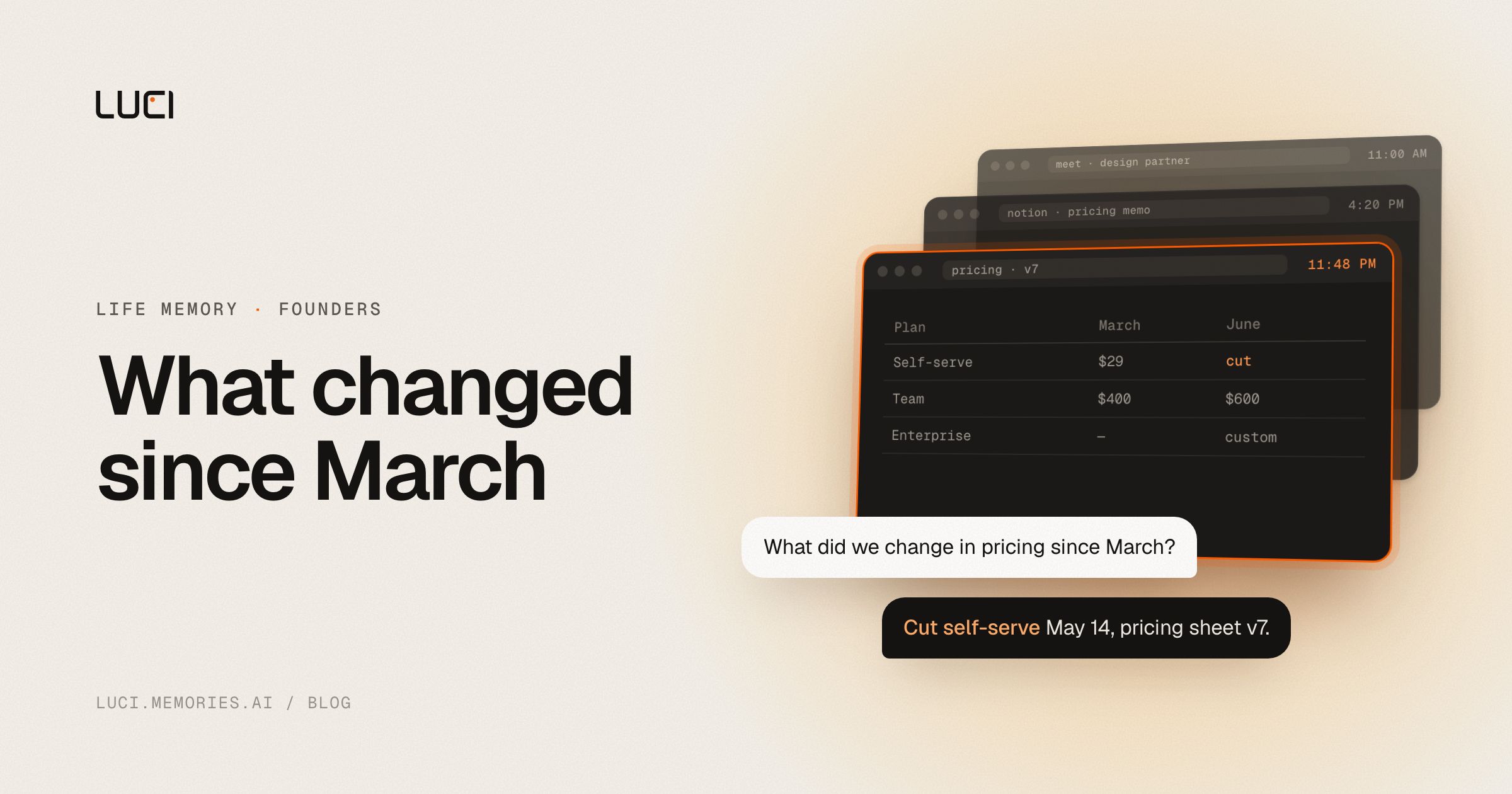
An investor emails on a Thursday afternoon with one question: what changed since March?
It is not a hard question. You lived every week of it. But the answer is scattered across a Slack channel you have scrolled past a thousand times, a Figma file with three abandoned branches, the call where you talked yourself into killing the self-serve tier, a Notion doc that stopped being true in May, and a pricing spreadsheet whose version history is the only honest record of what you actually charged people. Ninety minutes later you send the update with a hedge in it, because you still cannot place whether the churn conversation with your second design partner happened before or after you rebuilt onboarding.
Nobody failed to take notes. The problem is that your work has no memory outside the tools it happened in, and each tool only keeps its own slice.
The thing all of it has in common
Read that list again. Slack, Figma, a video call, Notion, a spreadsheet. Different vendors, different data models, no shared history. One property is true of every item: it happened on your computer.
That is what LUCI records. Your whole day on the computer: meetings, email, code, everything in between. Both sides of the audio on calls, what was on screen, the documents you opened, the branch you checked out, the competitor pricing page you read at 1am while deciding whether to raise. It is understood on your machine and stored encrypted there, with no cloud processing of your memory, and you search it in plain English. Cards, keys, and passwords are blacked out before anything is saved, and you can exclude private windows.
This is not a meeting tool with extras. A founder's meetings are maybe two hours of a fourteen hour day, and the decisions you later need to defend usually are not in the meeting. They are in the forty minutes after it, alone, in a doc, with a calculator open in another tab.
Each day, your agent distills what happened and writes your Life: a folder of ordinary dated files on your disk, readable in any text editor, that outlives any app including ours.
Four things this actually changes
The investor update, built from evidence
You open Claude, which reaches your memory through the Agent Bridge. LUCI connects itself, nothing to set up. You ask it what shipped between March and June and what you changed your mind about along the way. It reads the relevant days rather than the whole archive, and comes back with the pricing pivot, the two enterprise calls that caused it, and the week the activation number moved. You are editing a draft instead of excavating your own past.
Decision provenance
Every founder has a Wednesday where an engineer asks why the schema looks like that and the only available answer is "we discussed it." Ask instead: "when did we decide to store sessions per workspace, and what was the alternative we rejected." The answer lives in a call from February plus the whiteboard you screen-shared during it. Reconstructing intent is what stops a rewrite from happening twice.
Your coding agent finally knows the product
This is the one founders underrate. Coding agents are strong and contextless. Yours does not know that the retry logic exists because a specific customer's webhooks time out, or that the admin panel is deliberately ugly because you shipped it in one night before a demo. When the agent can query your memory, it stops asking you to explain your own codebase back to it. "What did the customer say about webhook retries on the call last month" is a question your agent can now answer for itself before it touches the file.
The call you half remember
Pricing conversations are the worst offenders, because the number that matters is said out loud once and written down never. "What price did we quote in the Acme call" gets you the number and the sentence around it, which is the part that decides whether the number was a floor or an anchor. Same for "the dashboard I had open before standup," which is how you find the chart you cannot describe but would recognize instantly.
Where this is honest about its limits
Some of what a founder does is board-sensitive, and you should think about that before pointing an agent at it. Your memory stays on your machine, but what an agent reads reaches that model's vendor. LUCI hands over only what a query needs, and you pick the agent, and the Life folder survives whichever agent you pick. That is the real tradeoff, not a marketing line about data never moving.
Other limits worth saying plainly. LUCI is not open source, so the local-only claim is something you verify by watching the network, not by reading our code. It needs the machine on and capturing, so a week where you worked mostly from your phone is a week with a thin memory. A call you take walking to the office is not captured at all. And it remembers what passed through your computer, which means the hallway conversation that actually changed the roadmap is still only in your head, where it always was.
Start with one week
Install it, let it run through a normal week, then ask your agent something you would otherwise have looked up by hand. The first time it answers a question about March that you could not answer yourself, the pitch stops needing explanation.
Download LUCI for Mac or Windows. It is free. There is more on LUCI for founders.